
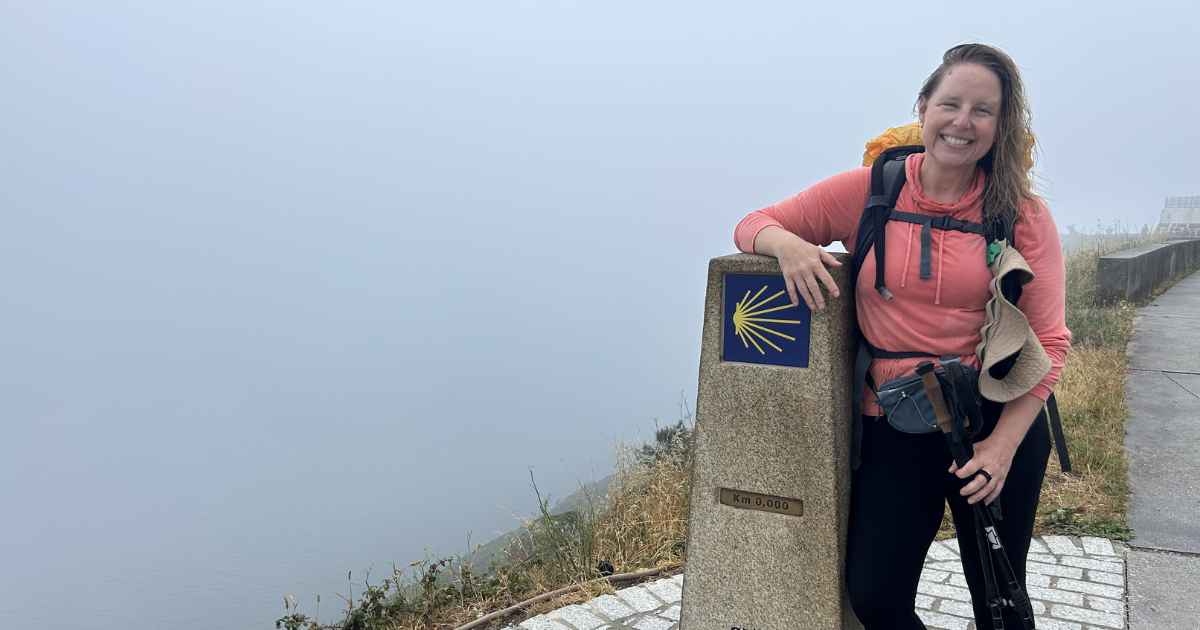
Andrea Tessier in Finesterre with the 0km marker the end of the Camino.
We weren't even out of the town we'd slept in the night before and my poor exhausted body and aching feet could not keep up with the group. I was falling behind. I knew it. And my FOMO parts were raging.
It was also the day we walked to Shit Town.
Shit Town cannot be found on any map. It's not even that it's a shitty town. It actually just smells like shit. Like, all day.
But I'm getting ahead of myself. Because shit town was the day. And there is much more I need to confess before we even get there.
I didn't set off on the Camino de Santiago with a specific intention. Only that I knew I was supposed to be there.
I'd been curious about the Camino for some time. But the logistics felt overwhelming until Jeremey came across my radar. Dr. Jeremy Goldberg; podcast host, speaker, coach, and someone I'd followed and already liked and trusted for years, mentioned he was taking a group to walk the Camino Português. Not his first group. His seventh. This is what he does.
It was a no-brainer. All I had to do was walk. I figured I could do that.
The Camino de Santiago, the Way of Saint James, is one of the oldest pilgrimage routes in the world, walked for over a thousand years by people carrying questions, grief, devotion, and everything in between. There are many routes. I walked the Camino Português, taking the train from Porto, through the border town of Tui, walking over 100km into Santiago de Compostela, and all the way to Finisterre, the edge of the known world, where pilgrims once believed the earth ended and the sea began. Ten days. Over 200km.
I didn't know what it would ask of me.
I found out on day two.
Confession 1: I have rage in me. And it took a hill in Spain to let it out.
The day had a warmth to it. We stopped at a little pilgrim shop to pick up pins, joined the line for stamps in our pilgrim passports, proof, at the end, that you actually did the walk. I loved this part. Metaphorical gold stars collected along the way. My pilgrim passport is now one of my most meaningful possessions.
It was a good day. And then we hit the hill.
It didn't even have a name. It wasn't one of the biggest ones we'd encounter. It was simply the first real physical challenge and it felt endless. I was blended with the "just get through this" part of me, head down, grinding, chest burning, sweat dripping off my chin. Something was rising in me that had nothing to do with the incline.
By the time I reached the top I was enraged.
Not at the hill. Not at myself. At strangers. Specifically, one woman waiting in line for stamps. Her biggest mistake: just trying to have a nice little chat. I turned to my friend and said "I gotta get out of here. I hate that woman."
She was shocked.
I was too, honestly.
Thankfully she could see the humour in it. So could I. She looked at me and said "wow, I wouldn't have been able to tell that you were upset, you seemed so calm."
And that's the thing about the Camino. Things are always changing, changing, changing. The terrain, the experience, the emotions moving through you. As you walk, it shifts. The rage I felt at the top of that hill was only one moment in a day that also held joy, laughter, and lightness. Nothing stays. You just keep walking and something new arrives.
The next day I was dreading the hills before we even started. I was worried I'd be filled with rage again. When I felt the intensity rising in my chest, my coach brain switched on. Oh. I know what this is. I focused on the sensation. I let my body depressurize, grunting, sighing, breathing into it. It helped. But I knew I needed more.
We were walking through forest most of the way. Large trees, ferns, mist visible above the canopy, sunlight shining through. Quiet and lovely. These plant allies were with us constantly.
I stepped off the path and into the trees.
I wasn't spiraling. I wasn't unhinged. I was intentional. I chose to go in. I asked to be held.
"Thank you plant allies for helping me release what needs to be released so I may create space for what I need."
And then I screamed. A deep, guttural, visceral scream.
Pilgrims walked by on the path. Not one of them said a thing. Just walked on in true pilgrim solidarity. The only one who checked in was Jeremy.
"Nothing is wrong," I told him. "I was just reorganizing."
The screaming gave way to hysterical laughter, and then tears. I don't know what I was moving. Only that it moved. And when it did, I felt incredible. The best day of the whole walk. No shame for making sound. No apology for taking up space in that forest. Empowered.
This is what I'd tell clients to do.
I settled back into my pace, back into my rhythm. And somewhere in that settling, it arrived. Not as a thought exactly, more like a knowing:
These hills aren't my enemy. They aren't here to break me. These hills have been shaping pilgrims for hundreds of years. Now it's my turn. The Camino and all her terrain is here to make me. Stronger, healthier, more resilient. An alchemical force creating heat within me. For my transformation.
And then the bigger realization:
Camino IS life. And all of life is happening for me.
That was Confession 1. There are two more, and they are cringier.
Confession 2 is about what happened when my overachieving brain tried to figure out surrender.
Confession 3 is about the longest, hottest, most fragrant day of the walk, a hill with a very ominous name, and the abandonment wound I'd spent years making sure I'd never have to feel.
Read the full Camino Confessions on Substack.
Or if you want the raw, unfiltered version of the wound story, the one I couldn't quite bring myself to write, come find me on YouTube.
If you made it to the end of a Camino confessional about cow shit and abandonment wounds, I have a feeling you're my kind of person. Nothing Is Wrong With You is a free audio series I made for women who are done making themselves wrong. It's where we start.
Already know you're ready? Apply for High Capacity coaching here: https://andreatessier.com/one-on-one-coaching
You might also like:
Andrea Tessier is a Master Life Coach and Level 2 Internal Family Systems (IFS) Practitioner who helps leaders and visionaries trust themselves and lead from inner authority. Her work bridges psychology and soul, blending IFS with intuitive, embodied mentorship to support clarity, self-trust, and self-led living.
Learn more at: https://www.andreatessier.com/
YouTube: https://www.youtube.com/@IFScoachAndrea
Instagram: https://www.instagram.com/andreatessiercoaching